
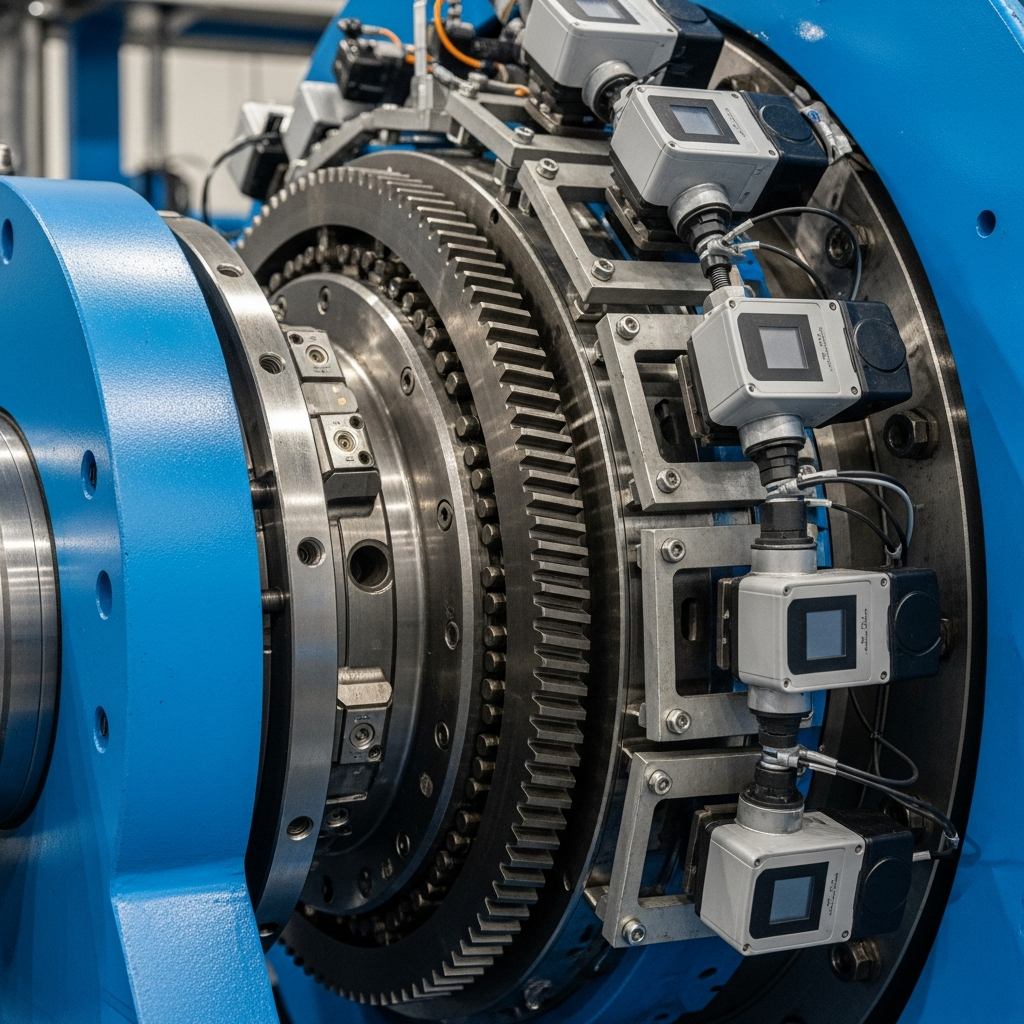
Why Vibration Analysis Matters
Every piece of rotating machinery produces vibrations. When equipment is healthy, these vibrations follow predictable, repeatable patterns. When problems develop—whether it's a bearing starting to fail, a shaft going out of alignment, or a rotor becoming unbalanced—the vibration signature changes in specific, measurable ways.
Vibration analysis allows trained reliability professionals to detect these changes early, often months before the problem becomes severe enough to cause an unexpected shutdown. This advance warning provides the time needed to order parts, schedule labor, and plan the repair during a convenient window—turning what would have been a $50,000 emergency into a $5,000 planned repair.
Understanding the Basics: Amplitude, Frequency, and Phase
Amplitude: How Much Is It Vibrating?
Amplitude tells you the severity of vibration. It can be measured in three ways:
- Displacement (mils or microns): The actual distance the machine moves. Most useful at low frequencies (below 600 CPM) for evaluating structural movement and shaft displacement.
- Velocity (in/s or mm/s): The speed of movement. The most commonly used measurement for general machinery monitoring because it provides a relatively flat response across the frequency range of interest (600-60,000 CPM).
- Acceleration (g's): The rate of change of velocity. Best for detecting high-frequency faults like bearing defects and gear mesh problems.
Frequency: What's Causing the Vibration?
Frequency is the diagnostic key. Different faults produce vibration at different, predictable frequencies:
- 1x running speed (1x RPM): Unbalance, bent shaft, misalignment
- 2x running speed: Misalignment (often dominant), looseness
- Bearing defect frequencies (BPFO, BPFI, BSF, FTF): Calculated from bearing geometry, these frequencies pinpoint which bearing component is failing
- Gear mesh frequency: Number of teeth multiplied by shaft RPM—sidebands around this frequency indicate gear problems
- Electrical frequencies (line frequency, 2x line frequency): Motor electrical faults, broken rotor bars, stator eccentricity
Phase: Where Is the Problem?
Phase measurements compare the timing of vibration at different points on the machine. This is essential for distinguishing between similar faults. For example, unbalance and misalignment can both produce high 1x vibration—but their phase relationships are completely different. Unbalance shows in-phase readings around a bearing, while misalignment typically shows a 180° phase shift across the coupling.
Common Machinery Faults and Their Vibration Signatures
Unbalance
The most common cause of excessive vibration. Occurs when the mass centerline doesn't coincide with the geometric centerline of the rotor. Produces a dominant 1x RPM vibration that increases proportionally with speed squared. Phase is stable and readings are highest in the radial direction. Solution: precision balancing, either single-plane or two-plane depending on the rotor geometry.
Misalignment
The second most common fault, responsible for roughly 50% of all rotating equipment problems. Angular misalignment produces axial vibration at 1x and 2x RPM. Offset (parallel) misalignment produces radial vibration at 2x RPM that's often higher than 1x. Modern laser alignment tools can achieve alignment tolerances of 0.5 mils or better, dramatically extending bearing and coupling life.
Bearing Defects
Rolling element bearings progress through four stages of failure:
- Stage 1: Microscopic spalling detected only in the ultrasonic range (250 kHz+). Bearing has 10-20% of remaining life consumed.
- Stage 2: Defect frequencies appear in the vibration spectrum. Bearing has used about 50% of remaining life.
- Stage 3: Defect frequencies become dominant with harmonics and sidebands. Audible noise may develop. 75-85% of life consumed.
- Stage 4: Broadband vibration increases dramatically. High-frequency energy floor rises. Failure is imminent—days to weeks.
The goal of a vibration program is to detect bearings in Stage 2, giving maximum lead time for planned replacement.
Looseness
Mechanical looseness—whether structural looseness (soft foot, loose bolts), component looseness (bearing fit), or rotating looseness (excessive clearance)—produces a vibration spectrum rich in harmonics of running speed. A spectrum showing many multiples of 1x RPM (3x, 4x, 5x, and beyond) often points to looseness as the root cause.
Setting Up a Vibration Monitoring Program
Equipment Selection
For route-based monitoring, you need a portable data collector/analyzer capable of collecting time waveforms, FFT spectra, and overall vibration levels. Leading platforms include the Emerson CSI 2140, SKF Microlog, and Pruftechnik VIBSCANNER. Budget $15,000-$40,000 for a quality portable system with software.
Measurement Point Setup
Consistency is critical. Define measurement points (horizontal, vertical, and axial at each bearing) and mark them permanently. Use threaded stud mounts for the best data quality on critical assets. Magnetic mounts are acceptable for routine monitoring if the mounting surface is clean, flat, and the magnet is strong enough to prevent rocking.
Data Collection Intervals
Base your collection frequency on asset criticality and failure mode progression rate:
- Critical assets: Monthly (or continuous online monitoring)
- Important assets: Quarterly
- General purpose: Semi-annually
Alarm Levels
Establish alert and alarm thresholds based on ISO 10816 guidelines, machine-specific baselines, or equipment manufacturer recommendations. Typical alert levels for general machinery: 0.2 in/s (velocity) triggers investigation; 0.4 in/s triggers planned corrective action; 0.6 in/s triggers urgent repair.
Getting Started
If you're new to vibration analysis, start with these steps: identify your 20 most critical rotating assets, establish baseline vibration readings, and begin trending. Even without advanced analysis skills, watching for upward trends will catch developing problems. As your program matures, invest in analyst training—Category I and II certification through the Vibration Institute or Mobius Institute provides the knowledge to extract maximum diagnostic value from your data.
G-Tek Enterprises offers vibration analysis services, program setup, and analyst training to help you build a world-class condition monitoring capability. Contact us to discuss how vibration analysis fits into your reliability strategy.